AI-powered translation services set the stage for a fascinating journey, showcasing how cutting-edge technology is transforming the way we communicate across languages. From enhancing accuracy to increasing efficiency, AI is revolutionizing the translation landscape.
In this article, we will delve into the concept of AI-powered translation services, explore the advantages it offers over traditional methods, examine the challenges and limitations faced, and speculate on the future trends that will shape the industry.
AI-powered Translation Services
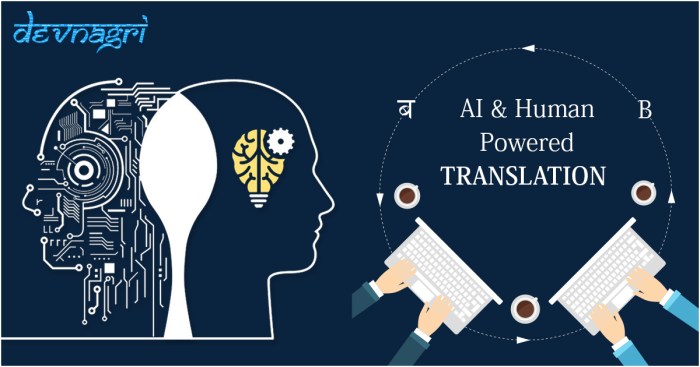
AI-powered translation services utilize artificial intelligence algorithms to accurately and efficiently translate text from one language to another. These services have revolutionized the way we communicate globally, breaking down language barriers and enabling seamless interactions across different linguistic backgrounds.
Examples of Popular AI-powered Translation Tools
- Google Translate: One of the most widely used AI-powered translation tools, offering translations in over 100 languages with text, speech, and image input options.
- Microsoft Translator: Known for its real-time translation capabilities, supporting text, speech, and image translations across multiple platforms.
- DeepL: A popular tool for its high-quality translations, utilizing deep learning technology to provide accurate and natural-sounding translations.
How AI Improves Translation Accuracy and Efficiency
AI enhances translation accuracy by analyzing vast amounts of language data to understand context, idiomatic expressions, and nuances that traditional translation methods may miss. Machine learning algorithms continuously improve through feedback loops, leading to more precise translations over time. Additionally, AI-powered tools can process large volumes of text quickly, providing efficient and timely translations.
Benefits of AI-powered Translation Services
- Accuracy: AI can provide more accurate translations by learning from vast amounts of data and improving over time.
- Efficiency: AI-powered tools can translate large volumes of text quickly, saving time and resources compared to manual translation methods.
- Cost-effective: Using AI for translation services can be more cost-effective in the long run, especially for businesses with frequent translation needs.
- Consistency: AI ensures consistent translations across different documents and languages, maintaining brand voice and message integrity.
Advantages of AI in Translation
AI algorithms have revolutionized language translation by offering a range of advantages over traditional methods. These advancements have greatly improved the accuracy, speed, and adaptability of translation services.
Enhanced Language Translation Capabilities
AI algorithms are capable of processing vast amounts of data at incredible speeds, allowing for more efficient and accurate translations. By analyzing patterns and context in languages, AI can produce high-quality translations that closely mimic human understanding.
Speed of Translation
Compared to human translators, AI-powered services can translate text at a much faster rate. This rapid turnaround time is especially beneficial for businesses and individuals who require quick and on-demand translations without compromising quality.
Adaptation to Different Languages and Dialects
AI excels in adapting to various languages and dialects, ensuring accurate translations across a wide range of linguistic nuances. Machine learning algorithms enable AI to continuously improve its language capabilities by learning from vast amounts of data, leading to more precise and contextually appropriate translations.
Role of Machine Learning
Machine learning plays a pivotal role in enhancing AI translation services by enabling algorithms to learn and improve from experience. Through the utilization of vast datasets, AI systems can refine their translation abilities over time, resulting in more accurate and reliable language translations.
Challenges and Limitations
AI-powered translation services encounter various challenges and limitations that affect their performance and accuracy. These factors can impact the quality of translations and hinder the overall user experience.One common challenge faced by AI-powered translation services is the difficulty in accurately capturing the nuances and context of human language. Languages often contain subtle nuances, idioms, and cultural references that can be challenging for AI systems to interpret correctly.
As a result, translations may lack the depth and cultural sensitivity that human translators can provide.Another limitation of AI in handling complex translation tasks is the inability to understand and accurately translate specialized or technical content. AI systems may struggle with industry-specific terminology, scientific jargon, or legal language, leading to inaccuracies in translation. In such cases, human translators with expertise in the field are better equipped to ensure precise and contextually relevant translations.For example, in legal or medical translations where precision and accuracy are paramount, human translators are preferred due to their ability to comprehend complex terminology and ensure the accuracy of the translated content.
AI systems may struggle to maintain the legal or medical accuracy required in such specialized fields.Despite advancements in AI technology, privacy and security concerns remain prevalent in translation services. AI-powered translation tools may pose risks related to data privacy, as sensitive information could be exposed or mishandled during the translation process. To address these concerns, AI developers need to implement robust security measures, encryption protocols, and data protection policies to safeguard user data and ensure confidentiality.
Human Translators vs. AI Systems
Human translators outperform AI systems in scenarios that require cultural sensitivity, nuanced language interpretation, and specialized domain knowledge. AI may struggle to capture the subtleties of human communication and provide accurate translations in complex or specialized fields.
Future Trends in Translation Services
As AI continues to advance, the future of translation services is set to undergo significant transformations. The integration of AI technologies is expected to revolutionize the way we communicate across languages, offering more accurate and seamless translation experiences.
Advancements in AI Language Models
- AI language models, such as GPT-3, are constantly improving in their ability to understand context and nuances in language, leading to more accurate translations.
- Developments in machine learning algorithms will enable AI to generate translations that are not only grammatically correct but also culturally sensitive.
- With the continuous training and refinement of AI models, the quality of translations is expected to reach near-human levels, reducing the need for human intervention in the translation process.
Integration with Speech Recognition
- The integration of AI-powered translation services with speech recognition technology will enable real-time translation of spoken language, facilitating effortless communication between individuals speaking different languages.
- Advancements in speech-to-text and text-to-speech technologies will further enhance the accuracy and speed of translation services, making them more accessible and user-friendly.
- By combining AI translation with speech recognition, users can experience seamless and natural communication in multilingual environments, breaking down language barriers in various settings.
Evolution of AI-Powered Translation Services
- Over the coming years, AI-powered translation services are expected to become more integrated into everyday communication tools, such as messaging apps and video conferencing platforms.
- The evolution of AI in translation services will not only streamline cross-language communication but also foster greater global connectivity and understanding among diverse communities.
- As AI continues to advance, the future of translation services holds the promise of breaking down language barriers and creating a more interconnected world where language is no longer a barrier to effective communication.
As we conclude our exploration of AI-powered translation services, it becomes evident that the intersection of artificial intelligence and language translation holds immense potential for the future. With continuous advancements and innovations, the realm of translation services is poised for unprecedented growth and transformation.
Common Queries
How accurate are AI-powered translation services?
AI-powered translation services have significantly improved accuracy levels compared to traditional methods, thanks to advanced algorithms and machine learning capabilities.
Can AI handle complex translation tasks effectively?
While AI has made great strides in translation capabilities, it still faces challenges with nuanced language nuances and cultural context, making complex tasks a bit challenging.
Are there instances where human translators outperform AI systems?
Human translators excel in scenarios requiring deep cultural understanding, context interpretation, and emotional nuances that AI may struggle to capture accurately.
How does AI address privacy and security concerns in translation services?
AI-powered translation services implement robust encryption protocols and data privacy measures to ensure the security and confidentiality of sensitive information during the translation process.


